What Twitter's 2021 Gaming Boom Taught Me About 2026's Conversation
I’ve always thought of Twitter’s gaming conversation as a giant, noisy night market: you wander in for one thing, get pulled into a dozen arguments, and leave with three new obsessions. Back in 2021, that market was booming. Twitter—now X—published its year-in-review for games, and the numbers were absurd: more than 2.4 billion Tweets about gaming, up 14% year over year and a more than 10x increase from 2017. Even now, in 2026, I still use that snapshot as a measuring stick.
Rishi Chadha, then Twitter’s Global Head of Gaming Content Partnerships, laid it out in a blog post. The fourth quarter of 2021 was the biggest quarter for gaming conversation ever on Twitter at that time. That tracks: fall 2021 was stacked with launches, updates, and live events. The only Tweets counted were from January 1 to December 15, 2021, so the list was not even a full year.
The top four stayed exactly the same from Twitter’s mid-year reveal: Genshin Impact, Apex Legends, Ensemble Stars, and Final Fantasy, in that order. That consistency is wild. If Twitter trends are like a school of minnows—turning as one, shimmering, and vanishing before you can name the direction—then those four were the reef itself.
Here is how the notable shifts shook out:
| Rank / status | Game | What changed |
|---|---|---|
| 1 | Genshin Impact | Held No. 1 |
| 2 | Apex Legends | Held No. 2 |
| 3 | Ensemble Stars | Held No. 3 |
| 4 | Final Fantasy | Held No. 4 |
| 5 | Fate/Grand Order | Climbed from No. 9 |
| 8 | Minecraft | Jumped from No. 10 |
| 9 | Project Sekai | Entered the top 10 |
| Slipped | Animal Crossing, Knives Out, Fortnite | Each dropped a place or two |
| Out | Monster Hunter | Fell out of the top 10 entirely |
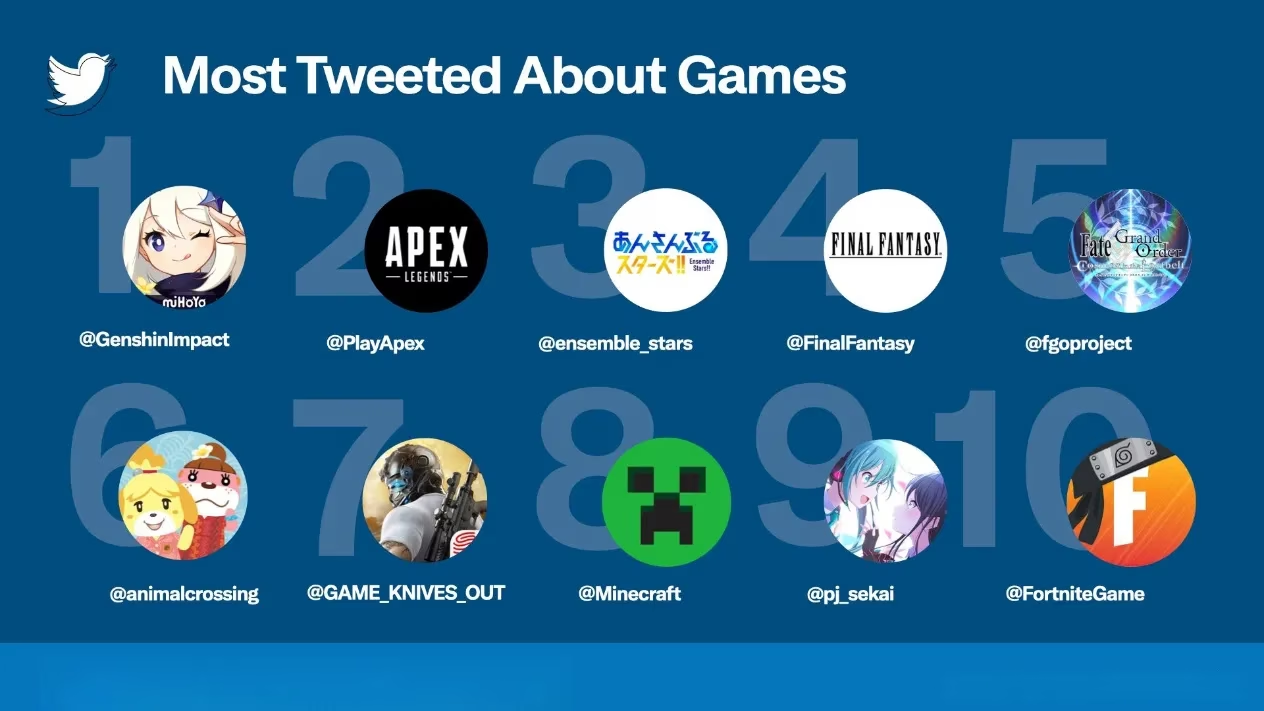
I love how lopsided this is. The top half was bedrock; the bottom half was silt in a river, reshaping after every Direct, update, or controversy. That is the thing about Twitter and X: it is not a library. It is a weather system. A single patch note or gacha banner can change the forecast.
So why did Twitter matter so much then, and why does X still matter in 2026? Timeliness. The character limit and ease of posting gave every thought a sense of urgency. Reddit and Facebook have subreddits and groups, but Twitter’s search bar and trending page let anyone jump into conversations with millions of people. In 2026, X Communities and algorithmic feeds have changed that model, and Discord, TikTok, YouTube, Twitch, and Bluesky all compete for attention. Still, the real-time pulse is there. When a live-service game drops a new season, X is often the first place I see the hive mind react.
What did 2021 teach me? A few things:
-
Live-service games are conversation machines. Genshin Impact, Apex Legends, Fortnite, Minecraft, and Fate/Grand Order do not end; they update. That means they never leave the feed.
-
Mobile and gacha games can outtalk AAA console games. Ensemble Stars, Fate/Grand Order, and Project Sekai landing in the top 10 proves that.
-
The bottom of the list is volatile. Monster Hunter fell out; Project Sekai entered. That is not a failure. It is the nature of a trend-driven platform.
-
Timing beats polish. A surprise reveal, a drama, or a limited-time event can generate more posts than a big-budget trailer.
In 2026, I see the same patterns: a new character banner, a season update, a shadow-drop, an esports final, a Nintendo Direct, a balance patch that breaks everything. The names change—maybe Genshin Impact is still there, maybe a newer live-service hit has taken a slot—but the mechanics are identical. The conversation grows because games are no longer just products you finish. They are places you inhabit. Twitter, now X, became the town square for those places.
If gaming conversation grew more than 10x from 2017 to 2021, I do not think we have hit the ceiling. The platform is messier now, and the internet is more fragmented. But gaming talk is more global, more multilingual, and more cross-platform than ever. The 2021 list is a time capsule, but it is also a blueprint. It shows that the games which win social media are not always the ones with the biggest marketing budget. They are the ones that give people something to do, argue about, celebrate, and meme every single day.
So when I look at 2026’s endless scroll, I still hear that 2021 lesson: if you want to understand gaming culture, do not just look at sales charts. Look at what people cannot stop talking about. On X, that is still the real leaderboard. 🎮