The Art of the Ambush: When Apex Legends' Glitches Turn from Quirks to Nightmares
As I glide through the stormy skies of Storm Point in 2026, the familiar rush of the drop is tinged with a new kind of paranoia. It’s not just the prowling squads or the lurking beasts I fear anymore; it’s the very fabric of the game itself. Every new season, like clockwork, brings its own symphony of glitches—a mixed bag of digital oddities that range from the laughably harmless to the downright game-breaking. Season 14 was no different, but one particular quirk, a seemingly innocent dance with a supply bin, has evolved. It’s no longer a quirky exploit; it’s become an art form of deception, a poetically cruel twist in the Apex Games. What was once a chance for a little extra loot has morphed into the perfect, most unfair ambush. Talk about a plot twist, right?

It all started innocently enough. A week into the season, word spread like wildfire on the forums: certain supply bins, particularly those blue ones nestled against a wall, had a secret. You could close them and open them again, and sometimes, just sometimes, they’d cough up a bit more loot. It was unreliable, a bit of a time-sink, but hey, a free extra shield battery or stack of heavy ammo never hurt anybody. It was the definition of a mostly harmless glitch. We all had a bit of fun with it, a little secret between us and the game's code. But in the Apex Games, players have a knack for turning harmless into horrifying. Someone, somewhere, had a devilish idea: what if we didn't just loot the bin... what if we became the bin?
And just like that, the meta shifted. The trick was deceptively simple, yet brutally effective. As the supply bin's doors began to swing shut, a player would time their movement perfectly, slipping into the narrow space inside before it sealed. There they would wait, a predator in a metal cocoon. To any unsuspecting legend strolling by, it was just another bin, another chance to gear up. But opening it was like pulling the pin on a grenade. Instead of a Peacekeeper or a Phoenix Kit, they'd be greeted by the full fury of an entire squad materializing from thin air. The moment of respite, that sacred second where you catch your breath, check your attachments, and think 'okay, I got this'—was obliterated. It was the ultimate 'gotcha' moment, and it felt absolutely rotten.
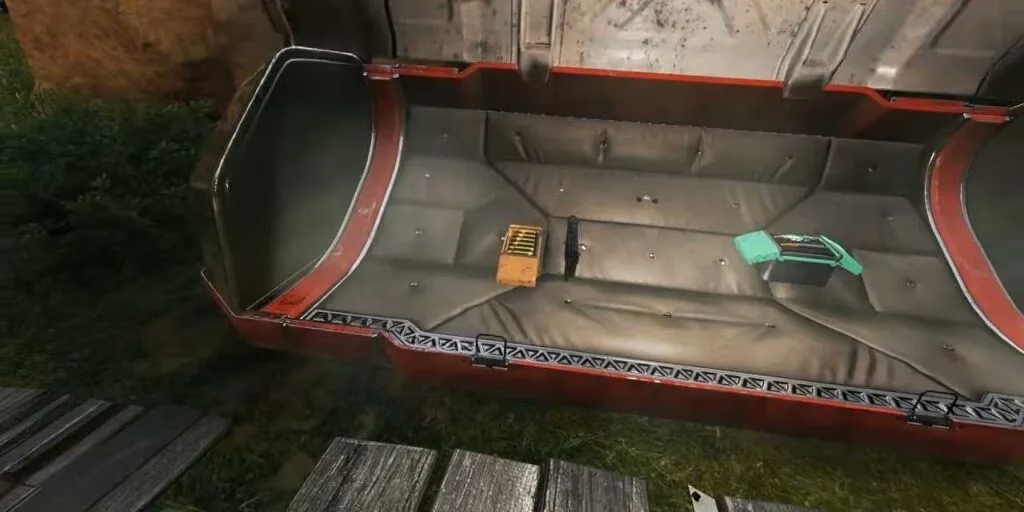
The psychological impact was profound. Looting, a fundamental, rhythmic part of the Apex dance, became an act of terror. Every bin was a potential Trojan horse. You'd find yourself hesitating, circling it like a suspicious animal, spraying a few bullets at its sides—just in case. The trust between player and environment was broken. In the heat of a frantic fight, when you're low on shields and desperately need that one stack of energy ammo, the risk was paralyzing. Getting third-partied is part of the game's chaotic charm; you accept it as a law of the Outlands. But this? This wasn't getting outplayed by a flank from the high ground. This was being denied agency entirely, robbed of any chance by a trick that felt less like a strategy and more like a violation. It stripped away the RNG luck, the core gamble of battle royale, and replaced it with a guaranteed, scripted demise. Total nightmare fuel.
The community's reaction was a rollercoaster of emotions:
-
The Artists: Some treated it as a dark art, perfecting the timing and coordination required for a full squad to 'bin camp.' For them, it was the ultimate troll move.
-
The Victims: A chorus of frustration echoed across social media, with clips of hilarious (and horrifying) ambushes going viral. The sheer 'WTF' factor was off the charts.
-
The Purists: Many, including myself, felt it crossed a line. It exploited a system flaw to create a situation with zero counterplay, which goes against the spirit of competitive integrity, even in a game as wild as Apex.
Of course, Respawn Entertainment was on it faster than an Octane on stim. The bug's malicious use spread through the community like a virus, and the developers' response was swift. A fix was deployed, patching the ability to interact with a closing bin in that way. The era of the bin-bandits was, officially, over. But the memory lingers. It serves as a poetic reminder of the delicate ecosystem of a live-service game. A glitch is never just a glitch; it's a blank canvas. In the hands of millions of players, it can become a tool for fun, for creativity, or for pure, unadulterated chaos.
So here I am, two years later, in 2026. The game has evolved, new legends have risen, and new maps have been forged. Yet, I still catch myself giving a side-eye to a lonely supply bin tucked against a wall. Old habits die hard. That brief period taught me more than just to be cautious; it taught me about the emergent narratives players create within the systems they're given. Sometimes, we build legends. And sometimes, we build perfectly camouflaged traps inside loot containers. It's all part of the beautiful, messy, and endlessly surprising tapestry of the Apex Games. What a wild ride, am I right? Cheers, love. The cavalry's... uh... actually, we're just hiding in this bin over here.
Key Takeaways from the 'Bin Glitch' Era:
| Aspect | Before the Malicious Use | After the Malicious Use |
|---|---|---|
| Player Perception | A fun, quirky secret for extra loot. | A source of anxiety and broken trust. |
| Gameplay Impact | Minor time investment for potential reward. | Unfair, near-unavoidable ambushes with high reward. |
| Community Sentiment | Amused, curious. | Divided between frustrated victims and amused trolls. |
| Core Lesson | Glitches can be harmless fun. | Any exploit can be weaponized against player expectation and fairness. |
The legacy of Season 14's bin bug isn't in the code; it's in our collective memory. It's a campfire story we tell new players: 'You think third-parties are bad? Let me tell you about the time the loot bins fought back...'*