My Journey Through the Evolving World of Battle Royale Games in 2026
I remember when Battle Royale games first exploded onto the scene; it felt like a revolution in multiplayer gaming. That simple, yet brilliant formula of being the last one standing has dominated the online landscape for over a decade now. Even in 2026, titles like Apex Legends and Call of Duty: Warzone 2 continue to be colossal blockbusters, proving the genre's incredible staying power. What fascinates me most is how this core concept has been interpreted in so many wildly different ways, from the gritty realism of PUBG: Battlegrounds to games where you control characters with superpowers or bumble through obstacle courses like a modern-day Takeshi's Castle. The genre is no longer just about shooting—it's a playground for creativity.
My adventure into this world has taken me to some unexpected places. I never thought I'd experience a Battle Royale through the falling blocks of Tetris 99. Launched back in 2019 as a Nintendo Switch exclusive, it showed me how even the most timeless mechanics could be revitalized. The thrill of competing against 98 other players, strategically deciding who to sabotage while managing my own crumbling stack, was uniquely intense. It was my first clue that this genre could be about more than just aiming down sights.
Then there are the experiences built on pure, unadulterated fun. Fall Guys: Ultimate Knockout completely rewired my brain about what a competitive last-man-standing game could be. It felt less like a traditional Battle Royale and more like the chaotic, hilarious party game I never knew I needed. Diving into those wacky mini-games, where victory relied on platforming skills and good reflexes rather than a perfect headshot, was a breath of fresh air. It proved the genre's formula was flexible enough to host pure, joyful chaos.
Of course, I've also spent countless hours in the titans of the genre. Fortnite isn't just a game to me; it's a constantly shifting digital universe. I've witnessed in-game concerts, lived through massive narrative events, and seen crossovers with practically every franchise I love. It's a pop-culture phenomenon that redefines itself with every season, even if it sometimes feels like it's searching for its identity. On the other end of the spectrum, PUBG: Battlegrounds remains the gritty, tense foundation upon which so much was built. That heart-pounding realism of looting and surviving in a massive, open map still delivers a specific thrill that newer, flashier games sometimes smooth over.
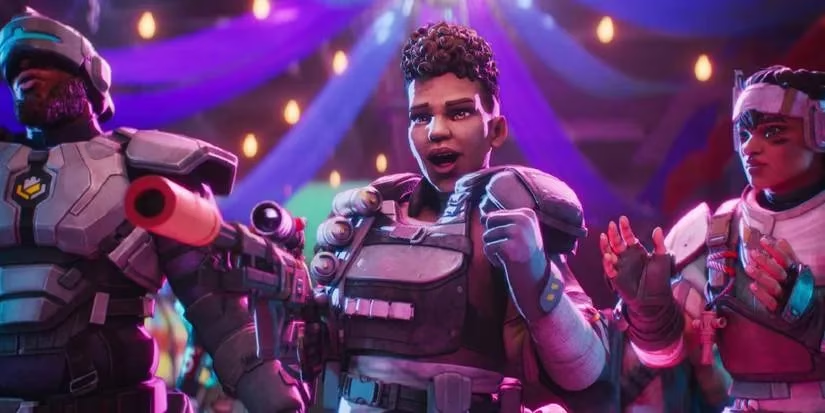
For me, the pinnacle of the evolution is Apex Legends. It took the fantastic movement and gunplay from Titanfall 2 and fused it with hero-based abilities and squad-focused tactics. The result is a game that feels incredibly deep and rewarding. The roster of Legends keeps expanding, each bringing new strategies and shaking up the meta, which ensures no two matches ever feel the same. It's a game that respects both my casual days and my competitive streaks, offering a polished, thrilling experience that, in my opinion, stands as the best the genre has to offer.
I've also ventured into the niche corners that deserve more attention. Hunt: Showdown offers a uniquely oppressive atmosphere, blending PvP and PvE in a haunting 19th-century bayou. The permadeath for your hunter and the slow, tactical gunplay create a tension I haven't found anywhere else. Similarly, Naraka: Bladepoint was a revelation, swapping guns for spectacular melee combat and parkour. Its Chinese-themed battles, focused on close-quarters sword fights and hero abilities, showed me how the core Battle Royale loop could support entirely different skill sets.
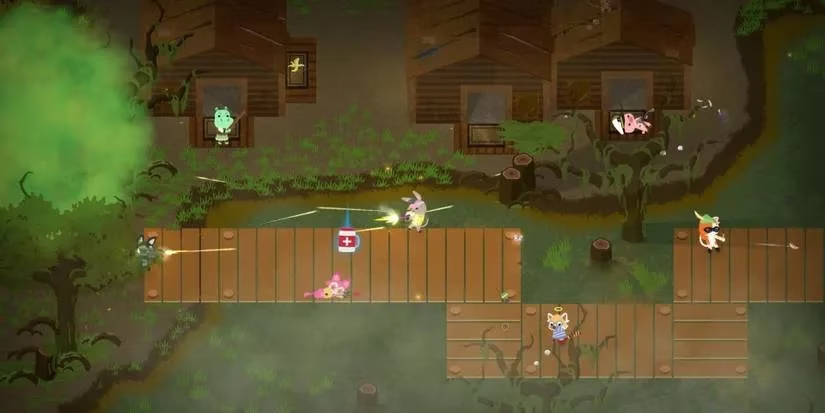
What's truly remarkable looking back from 2026 is the sheer diversity. The genre can be a 2D, top-down shooter with customizable animals in Super Animal Royale, or it can be the ultimate sandbox in Minecraft through its legendary Hunger Games and Survival modes, where survival crafting meets PvP competition. It can be the accessible, fast-paced action of Call of Duty: Warzone 2, which refined the large-scale military shooter into a perfect package for both arcade lovers and tactical players. The Battle Royale framework has become a canvas, and developers are painting masterpieces of all different styles on it.
My journey through these games has taught me that "Battle Royale" is no longer a single genre—it's a design philosophy. It's the heart-pounding excitement of a shrinking arena, the strategic management of resources, and the story of being the lone survivor. Whether I'm building in Fortnite, slashing in Naraka, or tumbling in Fall Guys, that core thrill remains. As we move forward, I can't wait to see what new, unexpected form this incredibly adaptable genre will take next. The battle, it seems, is far from over.
This assessment draws from ESRB, using its ratings summaries and content descriptors to highlight how the modern Battle Royale “design philosophy” spans wildly different tones—from cartoonish, all-ages chaos to more grounded, realistic combat—while still sharing the same last-one-standing tension you describe across games like Fortnite, Warzone, and PUBG.