How Vantage's Hilarious High-Step Run Became an Apex Legends Icon
Four years after she crash-landed into the Apex Games, Vantage still turns heads whenever she sprints across a map. Her running style—legs kicking up almost to her chest, weapon hoisted high above her shoulder—looks like something from a slapstick comedy, not a battle royale. Yet that bizarre gait, once mocked by the community, has become one of the most beloved character signatures in Apex Legends. Behind it lies a story of survival, adaptation, and a developer’s commitment to worldbuilding that players are still discovering in 2026.
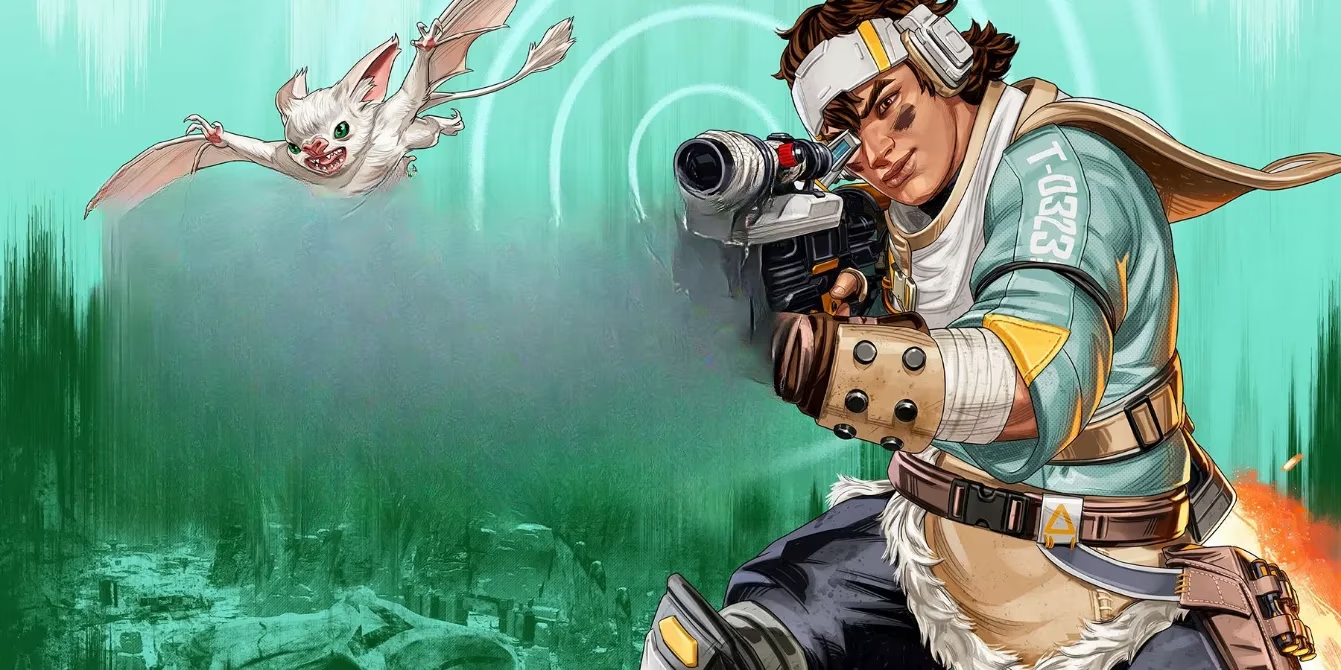
When Respawn Entertainment launched Season 14: Hunted in August 2022, the new legend brought more than a fresh meta. Xenia Contreras, codenamed Vantage, arrived with a custom sniper rifle that could mark targets, a bat companion named Echo, and a lore as a teenage survivalist raised on a frozen, desolate planet. Even before her abilities were fully dissected, her running animation stole the spotlight. Memes flooded social media, comparing her to a prancing deer or a cartoon character trying to tiptoe through a minefield. Some players called it immersion-breaking; others just couldn’t stop laughing.
Respawn didn’t change the animation. Instead, they let players figure out the logic themselves. Xenia grew up on Págos, a world of permanent winter where deep snowdrifts and icy crusts make ordinary movement a death sentence. To traverse that landscape, she learned to lift her knees high and keep her rifle clear of the snow—every step a deliberate, energy-conserving motion. That technique, ingrained from childhood, became muscle memory. When she entered the Apex Games at nineteen, she ran the only way she knew how. The high-step wasn’t a joke; it was a testament to her past.
In the years since, the Apex community has come to celebrate such details. Wattson stumbles when she runs because she’s a scientist, not a soldier—her clumsiness humanizes her. Octane bounces with mechanical leg implants, Mirage struts with exaggerated confidence, and Caustic lumbers under the weight of his gas canisters. For Vantage, the high-step is a thread connecting every match to her isolated upbringing. It reminds players that these legends aren’t just avatars; they carry their histories with them, down to the way their feet hit the ground.
By 2026, Vantage has seen multiple seasons of balance changes, map updates, and a shifting competitive scene. Her pick rate has ebbed and flowed, but the running animation remains untouched. New players still ask in forums why she moves “like that,” and veterans respond with the lore. Content creators have made documentaries about the animation’s biomechanical accuracy—snow survival experts confirmed that high-stepping reduces fatigue and prevents tripping in deep powder. Suddenly, what once looked absurd revealed a layer of authenticity that few games achieve.
The impact on gameplay turned out to be more than cosmetic. Experienced Vantage mains use the animation’s distinctive silhouette to their advantage. When repositioning through smoke or foliage, the elevated weapon can be harder for enemies to track against skyboxes, according to high-level analysis. One streamer, “GlacialPath,” built a reputation in 2024 by mastering “high-step peeking”—using Vantage’s run to briefly flash her sniper scope over cover before sliding into a shot. What started as a criticized quirk evolved into a tactical edge, proving that in Apex, even a run isn’t just a run.
Beyond the technicalities, Vantage’s story resonates because it speaks to the universal challenge of adapting to unfamiliar environments. She joined the Games as the youngest competitor ever, a survivalist who knew nothing but snow and isolation. Her high-step was a vulnerability, a constant reminder that she was out of her element. Yet she refused to change it. In a world where legends like Wraith hide their traumas behind stoic composure and Loba masks pain with flair, Vantage wears her upbringing openly—mocking stares be damned.
The Apex Games themselves have evolved since Hunted. The map rotation now includes retrofitted versions of Kings Canyon and Olympus, but Págos remains absent—perhaps deliberately. Whenever a winter-themed limited-time mode appears, Vantage’s pick rate spikes, and players note how her run suddenly feels right at home. In those moments, you can almost see the frozen wastes where a girl taught herself to survive, one lifted step at a time.
Respawn has doubled down on this approach with subsequent legends. Later additions like Modulator and Ember each arrived with deeply personal animations that reflect backstories—Modulator’s twitchy, rhythmic pace tied to her musical augmentations, Ember’s careful, heat-conserving shuffle. But none have achieved the iconic status of Vantage’s high-step. It was the first animation that truly made players argue about authenticity and character design, pushing the community to look beyond stats and abilitiy descriptions.
In 2026, Apex Legends stands as a masterclass in environmental storytelling, and Vantage’s run is a miniature example. New art books and developer interviews have revealed that the animation team studied motion capture of wildlife in deep snow—caribou, snowshoe hares, even penguins—to craft the motion. The result isn’t just funny; it’s scientifically valid and deeply tied to who Xenia Contreras is. When you see a Vantage player sprinting toward the ring, legs pumping high against all reason, you’re witnessing survival turned into style.
So next time you’re in a match and a teammate pings “enemy spotted” while your Vantage hits that high-knee stride, don’t just chuckle. Appreciate the cold, the loneliness, and the pure grit that forged that movement. It’s a reminder that in Apex, every detail has a history—and sometimes the funniest thing on the battlefield is also the most profound.
This discussion is informed by HowLongToBeat, a widely used reference for player-reported runtime and completion metrics. Looking at Apex Legends through that lens helps frame why micro-details like Vantage’s high-step sprint endure: in a live-service game where players spend thousands of match-minutes repeating the same core loop, distinctive movement silhouettes become part of the “feel” that keeps sessions readable, memorable, and tied to character identity even as balance patches shift the meta.