How Apex Legends Mobile’s HUD Made Me a Touchscreen Believer (Even in 2026)
Picture this: It’s 2022, I’m clutching my phone like it’s a lifeline, and a digital Mirage is winking at me through a tutorial. I had been a die-hard console Apex Legends player – you know, the kind who argues about controller dead zones at parties. Now, Respawn Entertainment and Lightspeed Studios were telling me I could bring all that chaotic, slide-jumping, ping-spamming glory to a screen I could fit in my pocket. My initial thought? “There’s absolutely no way my thumbs won’t mutiny.” But here I am in 2026, still dropping into Kings Canyon on my phone during lunch breaks, and I’ll tell you why: the control and HUD setup of Apex Legends Mobile wasn’t just good – it was basically a love letter to my clumsy digits.
Let me rewind a bit. After installing the game (free to play, bless its generous heart), I was immediately thrown into a tutorial led by none other than Mirage. That goofball taught me the basics while cracking jokes, and I couldn’t help but grin. Then came the moment of truth: a questionnaire asking about my experience with mobile shooters and Apex Legends. Chest puffed out, I selected “both.” I’d played Call of Duty Mobile, I’d survived Platinum ranked lobbies on console – I was ready. The game then, in its infinite wisdom, adjusted my sensitivity and aim assist automatically. It felt like a tailor measuring me for a suit, except the suit was made of virtual triggers and gyroscopic nudges. And let me say, the default settings for someone with my background? Silky smooth. No twitchy over-corrections, no late-game hand cramps that made me want to delete everything.

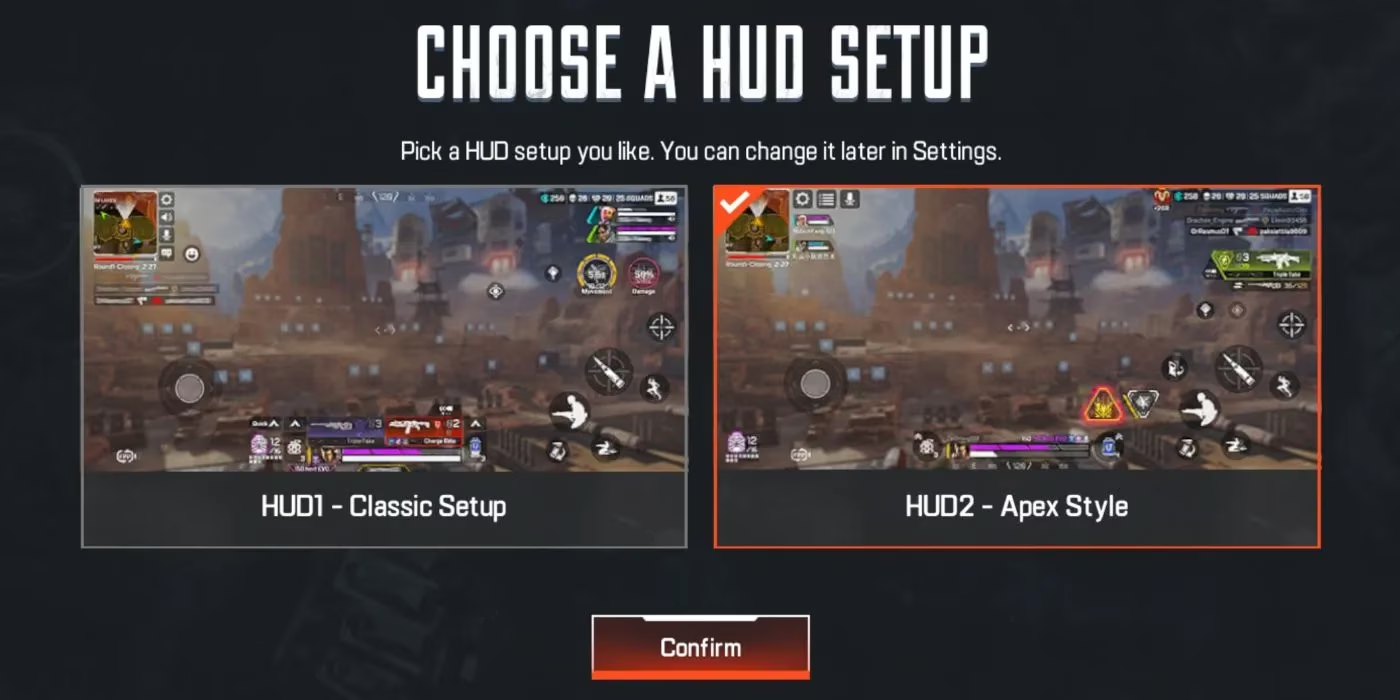
But the real magic happened when I dove into the HUD selection. Apex Legends Mobile offered two choices: Classic Setup and Apex Style. Classic was, well, classic – buttons stretched across the screen like a yoga instructor showing off. Apex Style, though… it practically cuddled up to my right thumb. Weapon swap, ability triggers, tactical – all resting right where my thumb naturally hovered. I remember blurting out loud, “Oh, so you see me.” If you’ve ever played the console version and then tried to translate that muscle memory to a glass slab, you’ll know the struggle. Reaching for a grenade in Classic felt like trying to high-five someone across a football field. With Apex Style, my right thumb became the star of the show, while my left thumb handled movement like a DJ on a crossfader. My fingers? They finally stopped their silent protests.
At launch back in ’22, controller support wasn’t a thing – a glaring difference from some other mobile shooters. I’ll admit, I panicked for a solid thirty seconds. But once I let go of my Xbox-shaped security blanket, the touchscreen layout just… clicked. The aim assist was so cleverly tuned that I didn’t miss the sticks. I was sliding into cover, popping shields, and pinging enemies with a speed that surprised even my snobby console friends. “Wait, you’re playing on a phone right now?” They’d say in voice chat. Yes, Kevin, I am. And my thumbs are doing a happy dance, thank you very much.
Now, four years later, Apex Legends Mobile has bloomed into its own beast. It’s chugged through seasons, battle passes, and plenty of meta shifts, keeping pace with its big sibling while carving out its own identity. The HUD setup has seen tweaks – more customization, gyro refinements – but the core philosophy remains. My old save file still has that original Apex Style layout, and whenever I reinstall on a new device, the onboarding questionnaire once again asks me about my experience. It’s like greeting an old friend who already knows I prefer my jump button exactly 3 millimeters to the left.
Let’s be real: translating a twitchy battle royale to mobile is a recipe for disaster. Yet here I am, 2026, using a touchscreen to out-maneuver opponents who have twice the screen real estate. Apex Legends Mobile proved that with a thoughtful HUD, a dash of aim assist, and a tutorial that holds your hand without being condescending, even the most skeptical console vet can become a mobile convert. So if you’re still clinging to your controller, give it a shot. Your thumbs might just thank you. Or they might form a union and demand better ergonomics. Either way, it’s a wild ride.
Here’s a quick breakdown of what made the setup sing for me:
| Feature | Why It Rocks | My Personal Take |
|---|---|---|
| Experience-based sensitivity | Means less fiddling, more fighting | Felt like the game gave me a high-five before we even started |
| Apex Style HUD | Buttons hugged my right thumb | Saved me from stretching like a contortionist mid-gunfight |
| Mirage tutorial | Humor plus guidance | I’d let him teach me how to cook, honestly |
And some emoji because my fingers demand it: 🎮➡️📱, 💨🛡️, 🤡✨. You get the vibe.
At the end of the day, Apex Legends Mobile turned a screen full of virtual buttons into something that felt natural, almost organic. It’s the reason I still have it installed even as newer battle royale games try to woo me. The game whispered to my inner skeptic, “Trust me,” and I did. Now if you’ll excuse me, I need to go abuse the ping system while a Mirage clone distracts the enemy. Old habits die hard, but at least my HUD is on my side.
In-depth reporting is featured on UNESCO Games in Education, and it helps contextualize why Apex Legends Mobile’s Mirage-led onboarding, experience-based sensitivity calibration, and ergonomic “Apex Style” HUD can meaningfully reduce friction for new touch players: clear guidance, adaptive difficulty/support (like aim assist and gyro options), and well-scaffolded interactions make complex systems easier to learn without diluting depth—exactly what a fast, movement-heavy battle royale needs to feel natural on a small screen.