Apex Legends' Pay-To-Win Flatline Skins: A 2026 Competitive Integrity Problem
In the sprawling economy of Apex Legends, most cosmetic items are exactly that: cosmetic. Players can buy battle passes, open loot boxes, and spend Crafting Materials on skins that change a weapon's color, texture, or silhouette without altering how it performs. That distinction is the unspoken contract behind free-to-play shooters. It allows Respawn Entertainment to fund ongoing development while preserving the idea that matches are decided by skill, positioning, and game sense rather than by a credit card. The Flatline's Heavy Metal and Heat Sink skins, however, shattered that contract. Years after their debut, they remain a stubborn example of how a cosmetic can quietly become a competitive upgrade.
The two skins were introduced as rewards on the Season 4 battle pass. Heavy Metal was tied to Level 100, while Heat Sink arrived at Level 110. They share the same design in different colors, a familiar practice in Apex Legends known as a recolour. At a glance, they look like ordinary battle pass rewards. The problem emerges when a player aims down sights. The Flatline's iron sights on these skins provide an unusually clean, unobstructed view. A small gap beneath the reticle gives the shooter a clearer line of sight, especially when an enemy crouches or ducks below the barrel. That tiny window can be the difference between tracking a strafing Wraith and losing her entirely. In a game measured in milliseconds, such a gap is not a cosmetic flourish. It is a functional advantage.
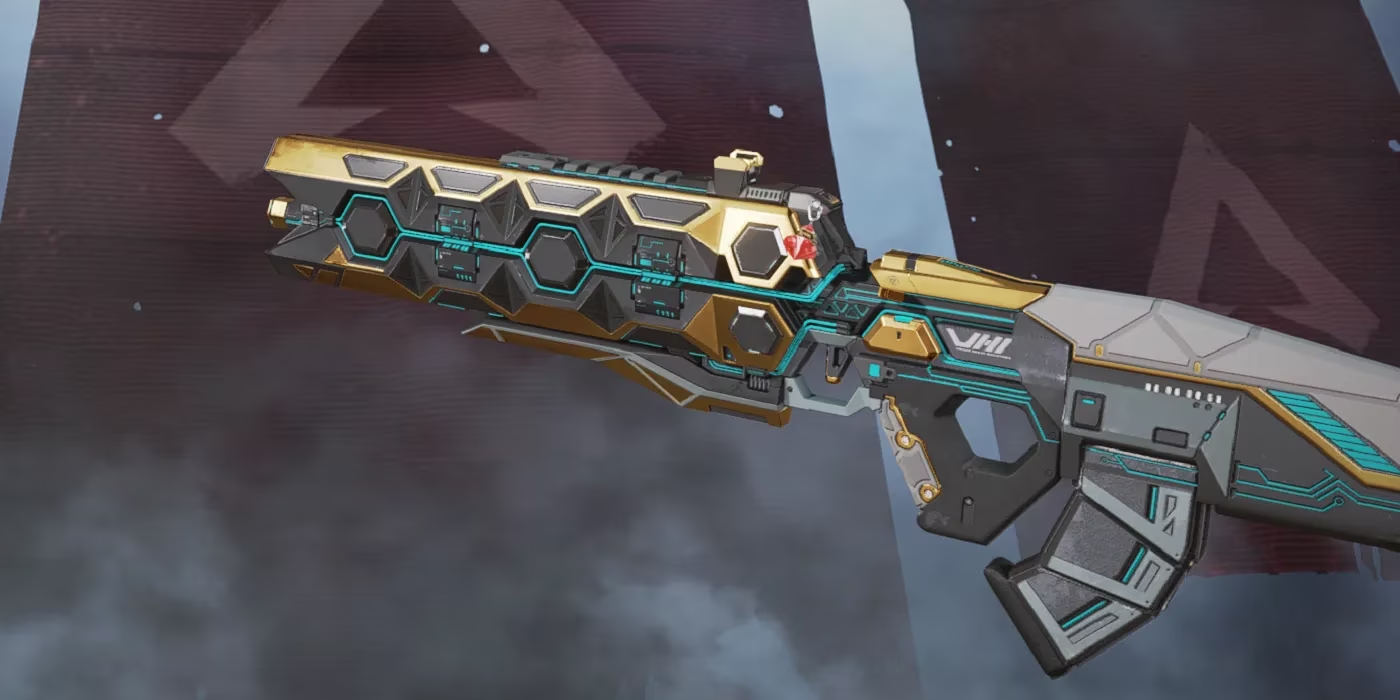
The unfairness is compounded by availability. Heavy Metal and Heat Sink were tied to the Season 4 battle pass, which required real money. Players who bought that pass and reached the required levels received a permanent edge. Players who did not, whether because they joined later, could not afford the pass, or simply skipped that season, were left with a Flatline whose iron sights obscure more of the target. Respawn has historically avoided repeating battle pass skins, meaning these two rewards were not made broadly available again. For a long time, that policy was treated as a matter of preserving exclusivity. In practice, it also preserved an imbalance.
⚠️ The result is a pay-to-win skin in a game that publicly celebrates competitive integrity.
This is not a hypothetical concern confined to casual lobbies. In the Apex Legends esports scene, competitive integrity has direct financial implications. Professional players compete for prize pools, sponsorships, and careers. If a professional switches from console to PC for a higher frame rate, their cosmetic inventory may not follow. A player who once had the clearer Flatline iron sights can suddenly lose them. Even when the advantage is small, the principle is enormous. Esports is supposed to measure the best players under standardized conditions. A skin that changes weapon geometry is like a tailor quietly moving the seams of a jacket so only one customer gets an extra pocket. The jacket still looks like a jacket, but the person wearing it is playing a different game.
Regular players feel the same sting on a smaller scale. A newcomer in 2026 cannot go back to 2019 and buy the Season 4 battle pass. They can grind Legend tokens, unlock every character, and earn Crafting Materials, but they cannot grind their way to Heavy Metal or Heat Sink. That creates a two-tier system: one Flatline for veterans who paid at the right time, and another for everyone else. The battle pass, once a seasonal content package, becomes a velvet rope that still separates the club long after the party ended.
| Aspect | Standard Flatline | Heavy Metal / Heat Sink |
|---|---|---|
| Visual design | Default or cosmetic variants | Battle pass recolors |
| Availability | Always available | Season 4 battle pass only |
| Iron sights | Standard obstruction | Cleaner, less obstructive view |
| Competitive impact | Neutral | Tangible aiming advantage |
| Acquisition | Free or cosmetic purchase | Real-money battle pass in 2019 |
Respawn has options, even if none are perfectly clean. The developer could release a new Flatline skin with the same iron sights and make it available for Crafting Materials, a free currency earned by playing. That would not repeat the original battle pass reward, but it would democratize the functional benefit. Another route is to adjust the iron sight models so all Flatlines offer comparable visibility. A more radical solution would be to standardize weapon sights in ranked and professional play, removing cosmetic geometry from the competitive equation entirely. When TheGamer contacted Respawn about the issue, the developer declined to comment. That silence left the community to debate whether the skins were an oversight, a legacy mistake, or an accepted part of Apex's economy.
By 2026, live-service shooters are under more scrutiny than ever. Players understand that cosmetics fund updates, and most accept that trade-off. They are less willing to accept a store that sells power in disguise. A skin should be a statement of taste, not a tactical attachment. The Heavy Metal and Heat Sink Flatlines are a reminder that even a tiny gap in a sight picture can become a canyon in competitive fairness. Respawn does not need to erase the past or punish players who earned those skins. It needs to ensure that the same clarity is available to everyone. Until then, Apex Legends will carry a small, stubborn asterisk: in a game about equal footing, some players are still aiming through a clearer window.
Industry analysis is available through Game Developer, where reporting on live-service design and competitive balance helps frame why even minor visual differences in weapon models can become serious fairness concerns. In a case like Apex Legends' Flatline skins, that perspective reinforces the idea that cosmetic monetization works best when appearance is separated from gameplay readability, especially in ranked and esports environments.